
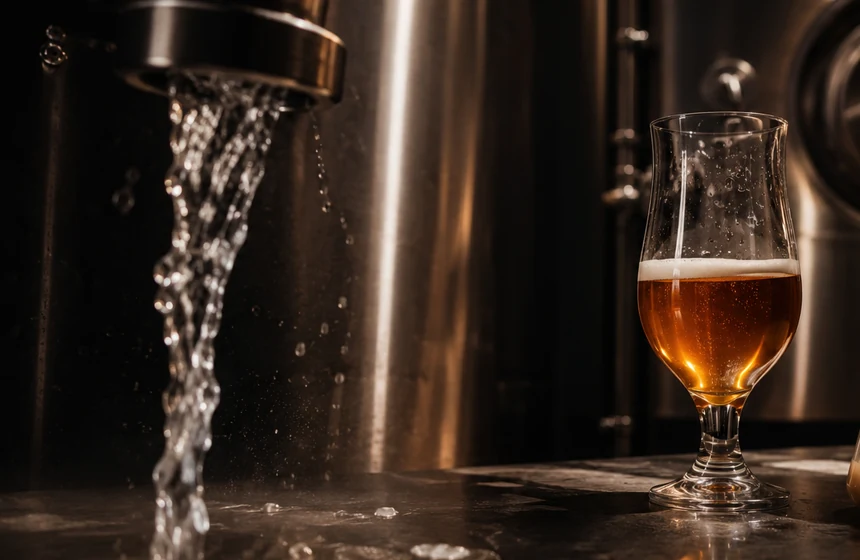
Water is not just the empty space between the interesting ingredients
Water forms most of a finished beer and its mineral composition affects both brewing chemistry and flavour balance. Brewers may filter it, remove disinfectants, reduce alkalinity or add mineral salts so the water suits the malt, hops, yeast and beer they intend to make.
Good drinking water is the starting requirement. It is not automatically ideal brewing water. A supply can taste perfectly pleasant yet contain enough alkalinity or chlorine to make a particular recipe awkward.
British brewers often call treated brewing water liquor. Nothing stronger has been poured into it; it is simply brewery language.
Why does water matter if it barely tastes of anything?
Water carries every dissolved ingredient through the process. Its chemistry influences mash pH, enzyme activity, extraction, protein behaviour, hop expression, yeast performance and the impression of fullness or dryness in the finished beer.
That does not mean a drinker can identify a town by taking one sip. Modern breweries analyse and treat water, and the effects of individual ions are part of a larger recipe. Malt, hops, fermentation, carbonation and serving condition all remain in the glass.
The raw water's pH is not the whole answer
Brewers pay close attention to alkalinity: the water's resistance to becoming more acidic. Two supplies can show a similar pH but behave very differently when mixed with malt.
What are brewers looking at in a water report?
| Calcium | Helps lower mash and wort pH, supports enzyme performance, protein precipitation and yeast flocculation, and plays several other practical roles. |
|---|---|
| Bicarbonate and alkalinity | Buffer acidity. Too much alkalinity can make pale grists difficult; darker malts contribute more acidity and may tolerate or require a different treatment. |
| Sulphate | Can sharpen the impression of dryness and hop bitterness. Excessive levels can become harsh or mineral. |
| Chloride | Can support fullness and roundness. Excessive levels can taste heavy or salty and may create technical problems. |
| Magnesium | A yeast nutrient in modest amounts, but usually much less central than calcium and unpleasant when excessive. |
| Sodium | Can add palate fullness at suitable levels but becomes obviously salty when pushed too far. |
Online brewing discussions often reduce this subject to a sulphate-to-chloride ratio. The ratio can be useful, but the actual concentration of each ion matters. A ratio of two to one tells you little if both numbers are tiny, and it does not rescue water with unsuitable alkalinity.
What do brewers change?
Analyse the supply
A brewery needs current information on alkalinity and key ions rather than relying on taste alone.
Remove unwanted character
Activated carbon, metabisulphite or other treatment may be used to deal with chlorine or chloramine, depending on the supply and system.
Control alkalinity and pH
Acid treatment, dilution or reverse osmosis can help create a suitable starting point for the grist.
Add useful minerals
Calcium salts may be used to support process needs and shape the balance between hop crispness and palate fullness.
Check the result
Brewers measure and taste through the process because recipes, seasons and water supplies can change.
Did local water create famous beer styles?
Local geology helped breweries develop regional strengths. Burton-upon-Trent became associated with pale, hop-forward ales and sulphate-rich water. Pilsen's much softer water suited the pale lager that made the city famous. Dark-beer centres often worked with supplies carrying more alkalinity.
That history matters, but it should not become a fairy tale in which water single-handedly invented every style. Ingredients, technology, trade, taxation, climate and consumer taste also shaped beer. Modern treatment means a brewery no longer has to accept its local water unchanged.
Can you taste the water?
Usually you taste its influence rather than a distinct “water flavour”. A hop-led beer may feel crisp and dry, a malt-led beer may feel rounder, or a poorly treated beer may show harsh mineral, salty, metallic or disinfectant-like notes.
Water also affects repeatability. A brewery making the same beer every week needs the brewing liquor to behave consistently even when the public supply changes.
“Soft water is always best for beer”
A low-mineral supply gives the brewer a clean base to build from, but many beers benefit from calcium, sulphate, chloride or controlled alkalinity. The best water is the water prepared for that recipe and process.
Water shapes the conditions in which every other ingredient works.
Brewers treat it less like a blank liquid and more like part of the recipe, because minerals and alkalinity affect both the process and the finished pint.
What people usually ask next
Is beer really about 90% water?
Many ordinary-strength beers are roughly 90% water, although the exact proportion varies with alcohol, extract and the style of beer.
What is brewing liquor?
In British brewery language, liquor means water prepared for brewing. It does not mean distilled spirits have been added.
Does hard water make better bitter?
Some mineral profiles can suit hop-forward beer, but hardness is a broad term. Brewers look at the actual calcium, sulphate, chloride and alkalinity rather than assuming all hard water is useful.
Can a brewery copy Burton water?
A brewer can adjust mineral levels toward a Burton-style profile, but copying an old published analysis exactly is rarely necessary and can produce excessive mineral character.
Why remove chlorine from brewing water?
Chlorine or chloramine can react during brewing and contribute unwanted medicinal or disinfectant-like flavours, so breweries commonly manage them before use.
Where this lesson comes from
This lesson translates brewing science into ordinary language. These sources support the technical details and examples.