
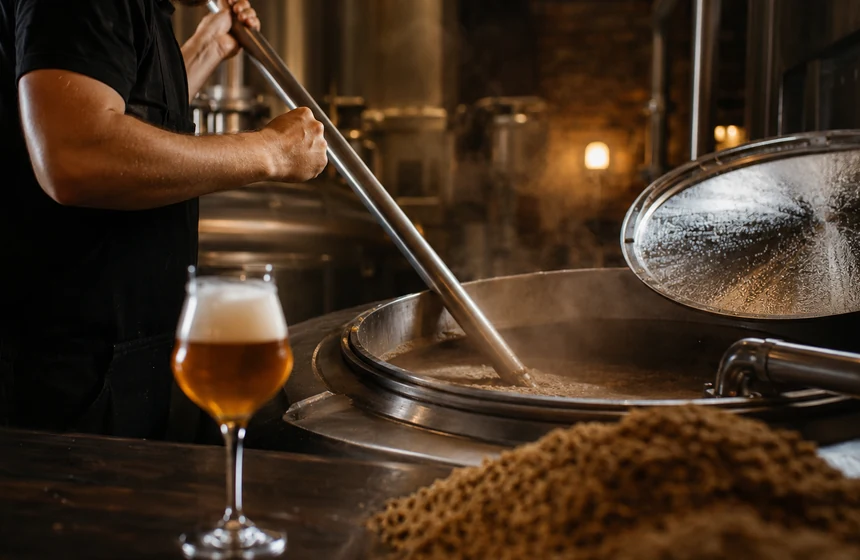
Grain makes sugar. Yeast makes beer.
Brewers crush malted grain, mix it with warm water to create sugars, separate the sweet liquid, boil it with hops, cool it and add yeast. The yeast ferments the sugars into alcohol and carbon dioxide while building much of the beer's flavour. The beer is then conditioned and packaged.
That same broad route can produce a crisp pilsner, a fruity Belgian ale, a bitter IPA or a rich stout. The difference lies in the ingredients, temperatures, timings and decisions made at each stage.
The four familiar foundations
Water
The main ingredient by volume and the medium in which the whole process happens.
Malt
The main source of starch, colour, body and grain flavour.
Hops
A source of bitterness, aroma, flavour and some protection against spoilage.
Yeast
The microorganism that performs fermentation and contributes its own flavour.
Many beers use more than these four. Other grains, sugar, fruit, spices and countless other ingredients can all be part of a legitimate recipe. The basic process still needs a source of fermentable material and a way to ferment it.
Malting prepares the grain
Most brewing begins before the barley reaches the brewery. A maltster steeps the grain in water, allows controlled germination, then stops the process with heat. This develops and preserves the grain's brewing potential.
The important technical distinction is easy to miss: malting prepares the grain, but mashing is where the brewer completes most of the starch-to-sugar conversion. Kilning and roasting also help create the colours and flavours available to the brewer, from pale and biscuity to toasted, chocolate-like and deeply roasted.
The maltster is part of the brewing story
Brewers choose malt for its extract, enzymes, colour, flavour and physical behaviour. A consistent pint begins with carefully grown barley and tightly controlled malting, long before the mash tun is filled.
From malt to packaged beer
Malt is prepared
Barley is steeped, allowed to germinate and then kilned. Malting prepares the grain so the brewer can later access and convert its starch.
The malt is milled
The grain is crushed to expose the inside while retaining enough husk to help separation later.
Mashing makes sugar
Crushed malt and warm water are mixed. Enzymes convert starch into a mixture of fermentable and less-fermentable sugars.
Sweet wort is separated
The sugary liquid is drawn away from the spent grain. Many breweries rinse the grain with more hot water, although not every system works the same way.
The wort is boiled
Boiling stabilises and concentrates the wort. Hops added here can develop bitterness, while later additions preserve more aroma.
The wort is cooled
Hot wort is cooled quickly to a temperature suitable for the chosen yeast.
Yeast ferments it
Yeast consumes fermentable sugars and produces alcohol, carbon dioxide and flavour compounds.
The beer conditions
Time allows flavour to settle and the beer to mature. Some beers are conditioned cold; others continue fermenting in a cask or bottle.
The beer is packaged
The finished beer goes into cask, keg, bottle or can. It may be filtered, naturally conditioned, force-carbonated, pasteurised or left live, depending on the beer.
Why mashing matters so much
Mashing is where the recipe begins to behave like a beer rather than a bag of grain. The brewer mixes milled malt with water and holds the mash within chosen temperature ranges so enzymes can break starch into sugars.
Some of those sugars are readily fermented by yeast. Others are less fermentable and remain to support body and sweetness. The grain bill, mash programme and yeast therefore work together. A higher-strength beer is not simply “fermented for longer”; it usually begins with more potential extract, and the yeast's ability to use it matters.
What happens in the kettle?
The wort is boiled to make it suitable for fermentation. Boiling stops the mash enzymes, drives off some unwanted volatile compounds, concentrates the wort and helps form material that can later be separated for clarity and stability.
It is also a major hop stage. Heat changes hop alpha acids into more soluble bitter compounds. Early additions have more time to contribute bitterness. Later additions preserve more volatile aroma. Many brewers also add hops after the boil or during fermentation for a fresher aromatic effect.
That timing is why “more hops” does not automatically mean “more bitter”. A heavily dry-hopped beer can smell intensely hoppy without having the sharpest measured bitterness.
Fermentation is not just alcohol production
Once the wort is cooled and oxygenated as required, the brewer adds yeast. Yeast consumes fermentable sugars, producing ethanol and carbon dioxide. At the same time it creates and transforms flavour compounds.
Different strains can make the same wort taste cleaner, fruitier, spicier, softer or drier. Temperature, pitching rate, oxygen, yeast health and pressure all affect the result. This is why good brewing is not finished when the kettle is switched off.
The recipe can be public and the beer still hard to copy
A list of ingredients rarely captures fermentation performance, yeast handling, oxygen control, tank geometry, water treatment and packaging. Process knowledge is a major part of a brewery's character.
Conditioning, carbonation and patience
Freshly fermented beer can contain rough flavours, suspended yeast and other material that needs time to settle or be processed. Conditioning allows the beer to mature towards its intended flavour and presentation.
Lagers are commonly conditioned cold. Cask-conditioned ale continues to develop with live yeast in the cask. Bottle-conditioned beer can undergo further fermentation in the bottle. Other beers are matured in tanks, filtered, centrifuged or pasteurised. None of those choices alone tells you whether the beer will be good. They are tools used for different products.
Packaging can protect or undo the work
Beer is sensitive to oxygen, heat, time and light. Filling casks, kegs, bottles and cans cleanly and with minimal oxygen exposure is crucial. Carbonation may be created naturally by fermentation or adjusted with carbon dioxide before packaging.
Once packaged, storage and serving still matter. A fresh hop-led beer left warm for too long will not show as the brewer intended. A bottle exposed to strong light can develop a distinctive light-struck aroma. The brewery may have finished brewing, but the journey to the glass is not over.
Thousands of beers, one broad process
| Change the grain | You change colour, body, sweetness, roast and the amount of material available for fermentation. |
|---|---|
| Change the hops | You change bitterness, aroma and flavours such as floral, herbal, citrus, pine or tropical fruit. |
| Change the yeast | You change fermentation performance and flavours ranging from clean and restrained to fruity or spicy. |
| Change the temperature | You alter enzyme activity, hop extraction, fermentation behaviour and conditioning. |
| Change the time | You alter extraction, fermentation, maturation, freshness and the final balance. |
The brewer is not merely following nine fixed steps. Every stage contains choices, and the choices interact.
“Beer is brewed in a day”
The hot-side work may happen within one working day. Fermentation, conditioning, maturation and packaging take longer. Some fresh ales and lagers move relatively quickly; stronger, cold-conditioned, sour or barrel-aged beers may need far more time.
The brewery makes wort. Yeast makes beer.
Brewing prepares the right environment and ingredients. Fermentation turns them into the drink, and careful conditioning and packaging protect the result.
What people usually ask next
How long does beer take to make?
The hands-on brew day usually takes hours, but fermentation and conditioning add days, weeks or sometimes months. The answer depends on the beer, the yeast and the brewery.
What is wort?
Wort is the sweet liquid made from malt and water before fermentation. Once yeast has fermented it, it becomes beer.
Why is beer boiled?
Boiling stabilises the wort, stops mash enzyme activity, drives off unwanted volatile compounds and allows hop bitterness to be developed. It also concentrates the wort.
Is all beer filtered and pasteurised?
No. Some beer is filtered or pasteurised for stability, while other beer is packaged unfiltered or with live yeast for further conditioning.
Is lager brewed differently from ale?
The brewhouse stages are broadly similar. The biggest differences usually come during fermentation and conditioning, where yeast choice and temperature have a major influence.
Where this lesson comes from
The page keeps the process readable, while the sources below support the technical sequence and ingredient roles.