
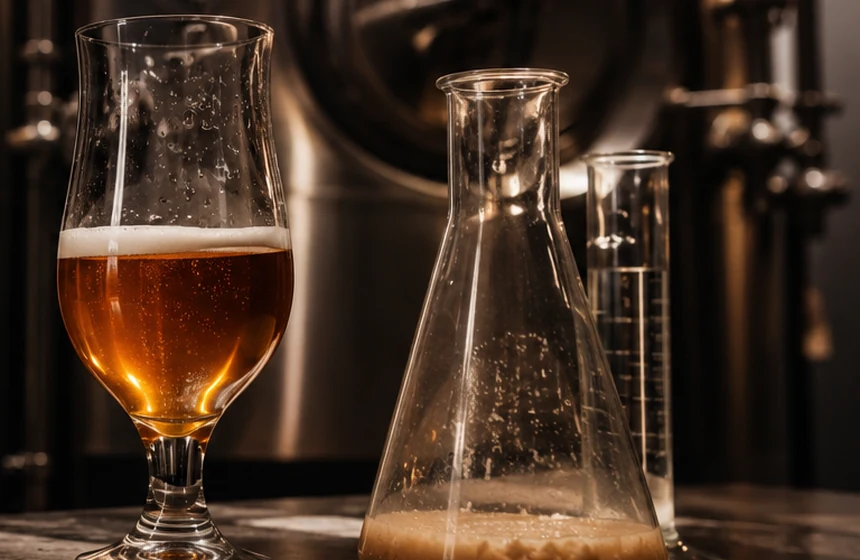
Yeast turns sweet wort into beer
Brewing yeast is a living microorganism that consumes fermentable sugars and produces alcohol, carbon dioxide and flavour compounds. The strain and the conditions around it can make a beer taste clean, fruity, spicy, soft, dry, sulphury or remarkably neutral.
Calling yeast “the thing that makes alcohol” is like calling a chef “the thing that makes food hot”. Correct, but missing most of the interesting work.
Brewers select yeast for fermentation speed, alcohol tolerance, attenuation, flocculation and, above all, the flavour profile they want in the finished beer.
What does yeast actually do?
After the wort has been cooled, the brewer adds a suitable yeast culture. The cells take up nutrients and ferment sugars, producing ethanol and carbon dioxide. Along the way they also form and transform many smaller compounds that shape aroma and flavour.
Alcohol
Ethanol is a main product of fermentation, but how much appears depends on the amount and type of fermentable sugar and the yeast's ability to use it.
Carbon dioxide
CO₂ may escape during tank fermentation, remain dissolved, or be used for natural conditioning in cask, bottle or keg.
Aroma and flavour
Esters, phenols, higher alcohols, sulphur compounds and other metabolites can be central to a beer's personality.
Finishing work
Healthy yeast can reduce compounds such as diacetyl and acetaldehyde late in fermentation when given enough time.
Two broad families, with plenty of complications
Most familiar ale strains belong to Saccharomyces cerevisiae. Traditional lager strains belong to Saccharomyces pastorianus, a hybrid with a strong ability to ferment at cooler temperatures.
Ale fermentation is commonly warmer and may express more fruity or spicy character. Traditional lager fermentation is commonly cooler, followed by maturation that encourages a clean, restrained profile. That is a useful beginner's distinction, not a universal law. Strains behave differently, brewers change conditions, and modern hybrid or selected yeasts blur the old boundaries.
“Top fermenting” and “bottom fermenting” are historical labels, not a full biology lesson
Some ale yeast can rise with foam and some lager yeast settles readily, but modern cylindroconical tanks collect both from the bottom. Species, strain behaviour and fermentation conditions tell you more than where a Victorian brewer saw the yeast.
How yeast creates flavour without adding fruit or spice
Whether a compound is welcome depends on the beer. Banana and clove can be exactly right in a German wheat beer and completely wrong in a clean pilsner. A low level of fruitiness may suit a British ale but distract from a neutral hop-led beer.
The yeast strain sets the possibilities. Fermentation management decides how those possibilities are expressed.
Why the same yeast can taste different
Temperature
Warmer or cooler fermentation changes yeast growth and flavour production, but the direction and size of the effect depend on the strain.
Pitching rate
Too little or too much yeast can alter fermentation speed, stress and flavour. Brewers aim for a healthy population suited to the wort.
Wort nutrition and oxygen
Yeast needs suitable nutrients and, at the beginning, enough oxygen for healthy growth and cell membranes.
Pressure and vessel shape
Tank pressure can suppress some ester and higher-alcohol production while changing other aspects of yeast performance.
Time
Rushing beer away from active yeast can leave compounds that would otherwise be reduced during the final stages of fermentation.
Attenuation and flocculation without the textbook
| Attenuation | How far the yeast reduces the wort's extract by consuming fermentable sugars. Higher attenuation generally means a drier finish, but mash composition and perception also matter. |
|---|---|
| Flocculation | The tendency of yeast cells to clump together and settle or rise out of suspension. It affects clarity, harvesting and how long yeast remains active in the beer. |
| Alcohol tolerance | The level of alcohol a strain can cope with before fermentation becomes difficult or stops. |
| POF positive | A strain capable of producing phenolic compounds that can smell spicy or clove-like. Useful in some wheat and Belgian styles, unwanted in many others. |
Does cloudy beer contain live yeast?
Sometimes, but haze is not proof. Beer can be cloudy because of suspended yeast, proteins, hop material, starch, fruit or deliberate process choices. A bottle-conditioned beer may contain a visible yeast sediment; a hazy IPA may owe much of its appearance to protein and hop interactions.
Yeast in the glass is not automatically a fault. In some beers it is traditional and contributes flavour or body. In others, the brewer works hard to make the beer bright and stable.
“Yeast only makes alcohol and bubbles”
Change the strain or fermentation conditions and the same wort can finish cleaner, fruitier, spicier, drier or fuller. Yeast is an ingredient and a process partner at the same time.
Yeast does not merely finish the recipe. It interprets it.
Malt and hops set the material, but the strain and fermentation conditions decide how much of that material becomes alcohol, aroma, flavour and texture.
What people usually ask next
Is yeast still alive in beer?
It can be. Bottle-conditioned, cask-conditioned and some unfiltered beers may contain live yeast. Filtered or pasteurised beers may contain little viable yeast or none.
What is the difference between ale yeast and lager yeast?
Most ale strains are Saccharomyces cerevisiae, while traditional lager strains are Saccharomyces pastorianus. Lager strains are well suited to cooler fermentation and clean flavour profiles, although practice is more varied than the simple labels suggest.
Does more yeast make more alcohol?
Not by itself. Alcohol potential comes mainly from fermentable sugar. The brewer needs enough healthy yeast to complete fermentation, but adding unlimited yeast does not create alcohol without more fermentable material.
Why does some beer taste of banana or clove?
Certain yeast strains produce fruity esters and spicy phenolic compounds during fermentation. Those flavours can be intentional even when no banana or cloves were added.
What does attenuation mean?
It describes how far fermentation reduces the wort's extract. A highly attenuating yeast usually leaves a drier beer, although the wort composition also controls what can be fermented.
Where this lesson comes from
This lesson translates brewing science into ordinary language. These sources support the technical details and examples.
- Lallemand Brewing: Precision flavour through fermentation control
- Lallemand Brewing: Lagering methods digest
- Fermentis: Questions and answers on ale and lager yeast taxonomy
- Brewers Association: Yeast resource hub
- Fermentis: SafAle W-68 sensory and fermentation profile
- Fermentis: SafAle US-05 sensory and fermentation profile