
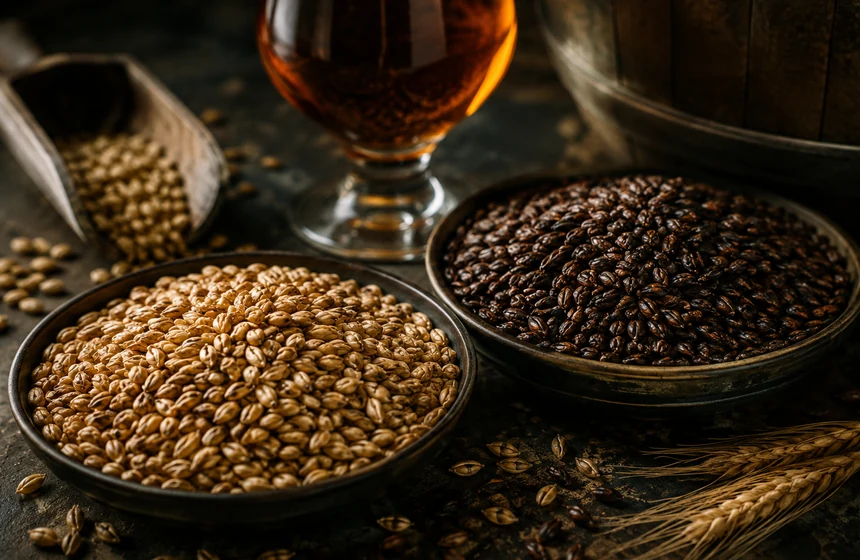
Malt gives beer its sugar, colour and backbone
Malt is grain that has been allowed to begin germinating and then dried with heat. In the brewery, its starch is converted into sugars that yeast can ferment. It also contributes much of beer's colour, body, foam and grain flavour, from fresh bread and biscuit to caramel, toast, cocoa and coffee.
Hops get more headlines. Malt does more of the heavy lifting. Without a source of starch or sugar there is nothing for yeast to ferment, and without malt character many beers would taste thin, sharp or oddly unfinished.
Barley is the classic brewing grain because it offers a useful balance of starch, enzymes, protein and a husk that helps during wort separation. Wheat, rye, oats and other cereals also appear in beer, malted or unmalted, depending on what the brewer wants.
What is the difference between barley and malt?
Barley is the seed harvested from the field. Malt is the result of putting suitable barley through a controlled biological process.
The maltster wets the grain so it begins to grow, allows internal changes to develop, then stops that growth with heat. The Maltsters' Association of Great Britain describes malting as controlled germination followed by drying and curing. The point is not to turn every grain into sugar at the maltings. It is to prepare the grain so the brewer can complete the important conversion during mashing.
The maltster has to stop a seed at exactly the useful moment
Leave germination running and the young plant starts consuming the grain's reserves for itself. Stop it too soon and the inside of the grain has not been prepared properly. Malting is controlled interruption, not simply drying wet barley.
How barley becomes brewing malt
Steeping wakes the grain
Barley is soaked and rested in air until it has taken up enough moisture to begin germinating evenly.
Germination changes the inside
The embryo becomes active and the grain develops the enzymes and physical modification needed for brewing.
Kilning stops growth
Warm air dries the green malt and stabilises it. The exact temperature and airflow help determine colour, aroma and brewing performance.
Roasting creates speciality malt
Some malts are roasted more intensely to make crystal, chocolate, black and other speciality products with deeper colour and stronger flavour.
Traditional floor maltings spread germinating grain across a floor and turned it by hand or machine. Modern maltings use vessels with controlled airflow, temperature and mechanical turning. The biology is ancient; the control is far more precise.
What does malt taste like?
These are comparisons, not proof that a loaf, chocolate bar or espresso went into the mash. Heat changes the grain and creates compounds that remind us of familiar cooked foods.
Malt also influences texture. Proteins and less-fermentable carbohydrates can contribute body and foam, while the balance of sugars produced during mashing helps decide whether the finished beer feels dry, rounded or rich.
Why brewers use more than one malt
| Base malt | Usually forms most of the recipe. It provides the bulk of the fermentable extract and enough enzyme activity to convert starch during mashing. |
|---|---|
| Kilned speciality malt | Adds bread crust, biscuit, toast, nutty flavours and warmer colours. |
| Crystal or caramel malt | Can bring caramel, toffee, dried-fruit character, colour and some less-fermentable material. |
| Roasted malt | Used in smaller amounts for chocolate, coffee, dark colour and roast character. |
| Roasted barley | A useful exception: it is raw, unmalted barley roasted very dark, commonly associated with dry stout character. |
A pale beer can be made almost entirely from pale base malt. A stout may combine pale malt for fermentable extract with small amounts of dark malt or roasted barley for colour and flavour. The darkest ingredient does not have to make up most of the recipe to transform the glass.
Can a beer taste malty without tasting sugary?
Yes. “Malty” describes grain-led aroma and flavour. “Sweet” describes a taste balance. A beer can be intensely bready and toasted yet finish dry, because yeast has consumed much of the fermentable sugar and bitterness or roast keeps the balance firm.
Equally, a pale beer can taste sweet if enough residual extract remains. Colour, malt flavour, body and sweetness are connected, but none is a reliable shortcut for the others.
“Dark malt makes stronger beer”
A small amount of very dark grain can turn a beer almost black without adding much fermentable extract. Alcohol strength depends mainly on how much fermentable material reaches the wort and how far the yeast attenuates it.
Malt is the grain made ready for brewing.
It supplies the material yeast turns into alcohol, while kilning and roasting help shape colour, body and flavours from bread and biscuit to coffee and cocoa.
What people usually ask next
Is all beer made with malted barley?
No. Malted barley is the most common base, but brewers also use malted wheat, rye and oats, plus unmalted cereals, sugars and other fermentable ingredients.
Is roasted barley a malt?
Strictly speaking, no. Roasted barley is unmalted barley that has been roasted very dark. It is widely used in stout and other dark beers.
Does darker malt contain more alcohol?
Malt contains no alcohol before fermentation. Dark colour does not automatically create a stronger beer; strength depends on fermentable extract and yeast performance.
What is crystal malt?
Crystal malt is produced by converting starch inside moist germinated grain and then roasting it. It can add colour and flavours such as caramel, toffee and dried fruit.
Why is barley so useful for brewing?
Barley offers starch, useful enzymes and proteins, and a husk that helps the brewer separate sweet wort from the spent grain.
Where this lesson comes from
This lesson translates brewing science into ordinary language. These sources support the technical details and examples.