
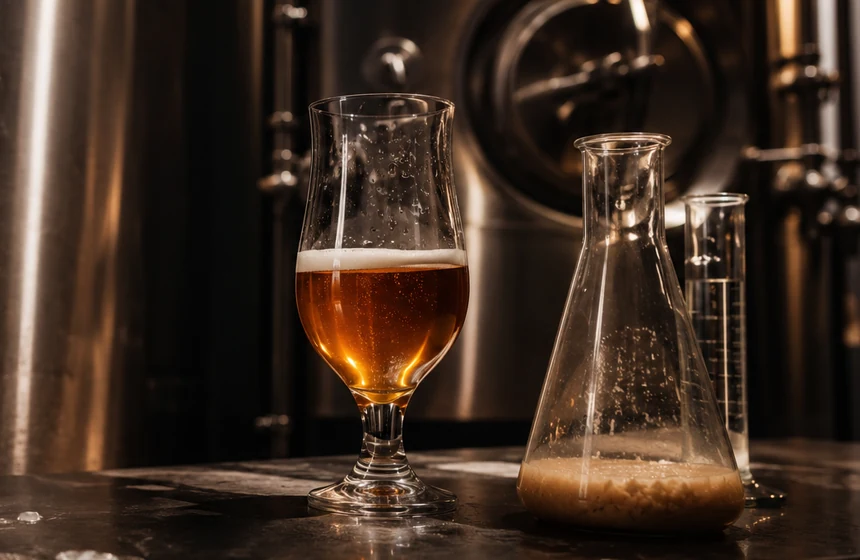
Fermentation is the stage where wort becomes beer
After the brewer cools the sweet wort and adds yeast, the yeast consumes fermentable sugars and produces alcohol, carbon dioxide and flavour compounds. Temperature, yeast health, time, pressure and wort composition all affect how cleanly fermentation finishes and what the beer tastes like.
Brew day makes the conditions for beer. Fermentation makes the beer itself.
It can look like a tank quietly sitting in a cellar, but inside it is a changing biological system: cells grow, sugars fall, alcohol rises, carbon dioxide escapes or dissolves, and flavour compounds appear and are sometimes removed again.
What has to happen before fermentation starts?
The wort must be cooled to a temperature suitable for the chosen yeast and transferred into a clean fermentation vessel. Brewers usually provide oxygen at this stage because yeast needs it early for healthy growth. A measured quantity of viable yeast is then pitched.
The yeast does not instantly produce a torrent of carbon dioxide. It first adapts to the wort, takes up oxygen and nutrients, and prepares to grow. The visible foam and vigorous gas production arrive later.
The quiet start still matters
A slow-looking first few hours are not necessarily a problem. Brewers judge fermentation using temperature, gravity, yeast health and expected performance rather than staring only at a bubbling airlock.
The useful four-stage version of fermentation
Adaptation
Yeast adjusts to the wort, takes up nutrients and prepares for growth. Visible activity may be limited.
Active fermentation
Cell growth and sugar consumption accelerate. Alcohol, carbon dioxide, foam and many aroma compounds are produced.
Attenuation slows
As the easier sugars are depleted, the rate drops and the beer approaches its expected final gravity.
Cleanup and maturation
Yeast can reduce compounds such as diacetyl and acetaldehyde. Settling, cooling and further conditioning prepare the beer for packaging.
These stages overlap. Brewing fermentation does not move through four perfectly separated boxes, and different yeasts or beer styles follow different timelines.
What changes the result?
Yeast strain
Sets the likely attenuation, flavour profile, alcohol tolerance, flocculation and working temperature range.
Temperature
Influences growth, fermentation rate and the production or reduction of esters, higher alcohols, sulphur compounds and diacetyl.
Pitching and health
The number and condition of yeast cells affect the lag phase, stress, completion and flavour consistency.
Wort composition
Sugar profile, nutrients, oxygen, gravity and pH determine what the yeast has to work with.
Pressure
Carbon dioxide pressure can suppress some ester and higher-alcohol production, while affecting growth and diacetyl management.
Time
Fermentation may reach its gravity target before the flavour is ready. Mature beer is not simply beer that has stopped bubbling.
Fermentation flavour can be the style, not a fault
A clean lager aims to keep fruity esters and higher alcohols restrained. A Belgian ale may rely on fermentation for pear, spice, pepper or warming complexity. A wheat beer may deliberately show banana-like esters and clove-like phenols.
Compounds such as diacetyl, acetaldehyde and hydrogen sulphide can be normal products or intermediates in fermentation. Whether they become faults depends on concentration, style and whether the yeast is given suitable conditions and enough time to reduce them.
Is lager fermented differently?
The basic job is the same: yeast converts wort into beer. Traditional lager strains are usually pitched in greater quantities and fermented cooler than ale strains. The beer is then commonly given a warmer finishing phase if needed and a period of cold maturation.
Ale fermentation is commonly warmer and faster, but “ale equals warm and fruity, lager equals cold and neutral” is only a map. Brewers can ferment some lager strains relatively warm, use restrained ale strains, ferment under pressure or make hybrid styles that ignore the tidy boxes.
Our yeast lesson explains the broad biological difference.
What about mixed and spontaneous fermentation?
Not every beer is fermented by one carefully selected brewing strain. Mixed fermentation may combine brewing yeast with Brettanomyces, lactic-acid bacteria or other microorganisms. Spontaneous fermentation exposes cooled wort to a brewery's environment and resident microflora before long maturation and blending.
These methods can create acidity, funk, fruitiness and deep complexity. They also require skilled control. “Wild” does not mean careless, and sourness does not automatically mean the beer has gone wrong.
“When the bubbling stops, fermentation is finished”
A sealed vessel may show little visible activity, a leaky vessel may never bubble properly, and yeast can still be reducing flavour compounds after rapid sugar consumption has slowed. Brewers confirm completion with measurements and sensory checks.
Fermentation is not a pause after brewing. It is the main performance.
Yeast, wort and conditions interact over time to determine alcohol, carbonation, dryness and a huge part of the finished flavour.
What people usually ask next
How long does beer fermentation take?
Active fermentation may take a few days or longer, while maturation and conditioning can add days, weeks or months. The yeast strain, temperature, gravity and beer style all matter.
Does fermentation create the bubbles in beer?
Yeast produces carbon dioxide. Some may remain dissolved or be retained during natural conditioning, while many packaged beers receive additional controlled carbonation.
What is a diacetyl rest?
It is a warmer finishing period, commonly used in lager brewing, that encourages yeast to reduce diacetyl and its precursors before the beer is cooled.
Can beer keep fermenting in the bottle or cask?
Yes. Brewers may add or retain yeast and fermentable extract so carbonation develops naturally after packaging. This must be carefully controlled.
Is spontaneous fermentation the same as infected beer?
No. Spontaneous fermentation is a deliberate method using environmental microorganisms, controlled through brewery practice, maturation and blending. An unwanted infection is not the same thing.
Where this lesson comes from
This lesson translates brewing science into ordinary language. These sources support the technical details and examples.
- Brewers Association: Fermentation resource hub
- Lallemand Brewing: Precision flavour through fermentation control
- Lallemand Brewing: An easy guide to brewing lager
- Lallemand Brewing: Alpha acetolactate decarboxylase and diacetyl
- Brewers Association: Managing hydrogen sulphide
- Brewers Association: Spontaneous fermentation in a production brewery