
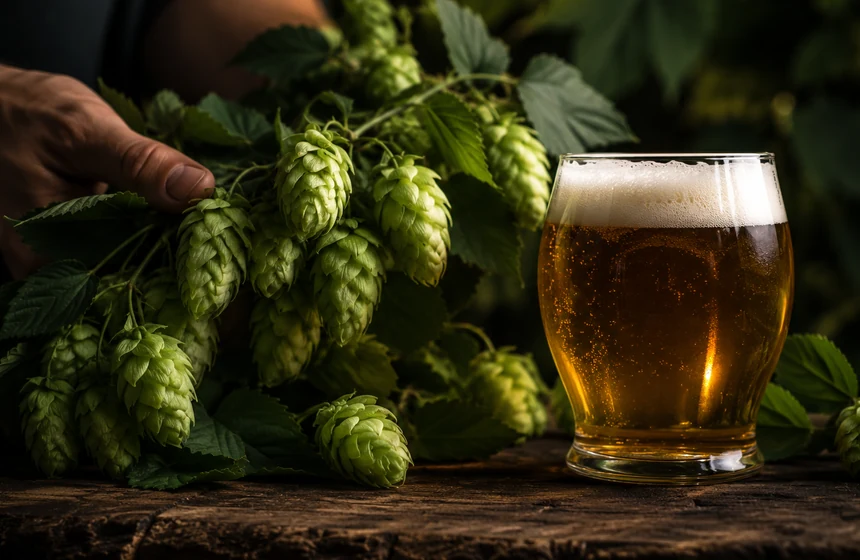
Hops balance malt and build aroma
Hops are the cone-like flowers of the hop plant. Their resins can create bitterness that balances malt sweetness, while their oils contribute aroma and flavour. The variety, quantity and timing of hop additions determine whether the result is gently herbal, firmly bitter, explosively fruity or somewhere in between.
A brewer can use the same hop in different ways. Add it to the boil and heat develops bitterness. Add it later and more aroma survives. Add it during or after fermentation and the beer can gain an intensely fresh hop character without simply becoming twice as bitter.
What exactly is a hop?
The hop plant is Humulus lupulus, a vigorous perennial climbing plant. Brewing uses the cones from female plants. Inside those cones are yellow lupulin glands containing resins and volatile oils.
The resins include alpha acids, important precursors of much of beer's familiar hop bitterness. The oils contain a complex mix of aromatic compounds. Different varieties contain different proportions, which is one reason hop flavour can range so widely.
Fresh hops need quick care
Newly harvested hop cones contain a great deal of moisture and deteriorate quickly. They are normally dried soon after harvest, then stored carefully or processed into pellets and extracts to protect brewing value and make handling more consistent.
How hops make beer bitter
During boiling, heat converts hop alpha acids into more soluble iso-alpha acids. Those compounds provide much of the clean, recognisable bitterness found in beer.
Varieties differ in alpha-acid content, so two equal handfuls of hops may have very different bittering potential. The length and vigour of the boil, wort gravity, equipment and other process factors also affect how much bitterness reaches the beer.
That makes “number of hops” a fairly useless comparison. Brewers calculate and measure much more than the weight added.
Hops can smell like far more than hops
These words are sensory descriptions, not proof that fruit or pine needles were added. Hop oils and their interaction with yeast can produce aromas that remind people of familiar plants and foods.
Origin matters, but broad stereotypes can mislead. British hops are not all quiet and earthy. The British Hop Association lists varieties with blackcurrant, lemon, grapefruit, peach, pineapple and passionfruit characteristics alongside traditional floral, herbal and spicy traits.
When are hops added?
Build bitterness
Longer exposure to heat favours the formation of bitter iso-alpha acids, although some flavour and aroma remain.
Keep more flavour
Shorter or cooler hot-side contact preserves more volatile hop character while still adding some bitterness.
Push aroma forward
Dry hopping extracts fresh aromatic character without the same boiling process. It can still alter bitterness and mouthfeel, so it is not chemically neutral.
Brewers often combine all three approaches. A modern IPA might use one addition for structure, another for saturated flavour and a final dry hop for aroma.
Why is it called dry hopping?
The name is slightly unhelpful. Dry hopping does not mean the beer is made drier, and the hops do not necessarily stay dry. It means hops are added to the cool side of the process rather than boiled in the kettle.
Because the most volatile oils are not exposed to a full boil, dry hopping can create vivid aroma. Contact time, temperature, hop form, movement, oxygen exposure and yeast activity all affect extraction and the final result.
Dry hopping can also change bitterness in complicated ways. Oxidised hop compounds can add bitterness, while hop material can remove some existing iso-alpha acids. The sensible beginner's rule is simply this: dry hopping is mainly an aroma technique, but it is not only an aroma technique.
Does a higher IBU always taste more bitter?
No. International Bitterness Units are useful analytical information, but your mouth tastes the whole beer rather than one laboratory number.
Residual sweetness can soften the impression of bitterness. Roast, acidity, alcohol, carbonation, water chemistry and hop-derived flavour all change the balance. Two beers with similar measured bitterness can feel very different, and some modern hazy beers have intense hop aroma with a comparatively soft bitterness.
A broader flavour map than the old stereotype
| East Kent Golding | Traditionally associated with earthy, herbal, spicy and woody character. |
|---|---|
| Bramling Cross | Known for blackcurrant, spice and lemon-like citrus. |
| Target | Can bring sage, citrus and spice, and can be used for bittering or aroma. |
| Harlequin | A modern British variety described with passionfruit, peach and pineapple notes. |
These are tendencies, not flavour guarantees. Crop year, growing conditions, storage, processing and brewing method all influence what reaches the glass.
“Hoppy means bitter”
A beer can have a strong hop aroma and gentle bitterness, or a firm bitterness with restrained aroma. Ask whether the beer is bitter, aromatic, resinous, fruity or dry-hopped rather than treating “hoppy” as one universal taste.
Hop variety matters. Hop timing matters just as much.
The same plant can build bitterness in the kettle, flavour late in the hot process and vivid aroma during dry hopping.
What people usually ask next
Do hops make beer alcoholic?
No. Alcohol is produced by yeast fermenting sugars. Hops mainly contribute bitterness, aroma, flavour and other brewing properties.
Does more hops always mean more bitterness?
No. Hop variety, alpha-acid content, timing, temperature and process all matter. Large late or dry-hop additions can create huge aroma without producing the highest bitterness.
What is dry hopping?
Dry hopping means adding hops after the wort has been boiled, commonly during or after fermentation, to extract aroma and flavour with little or no kettle-style isomerisation.
What does IBU measure?
IBU is a laboratory measure related to bittering compounds in beer. It is useful, but it does not perfectly predict how bitter a beer will taste because sweetness, alcohol, acidity, roast and other factors affect perception.
Are British hops only earthy and floral?
No. Traditional British varieties often show earthy, floral, herbal or spicy traits, but modern British breeding also produces citrus, blackcurrant and tropical-fruit profiles.
Where this lesson comes from
These sources support the plant biology, bitterness chemistry, dry-hopping explanation and British hop examples.